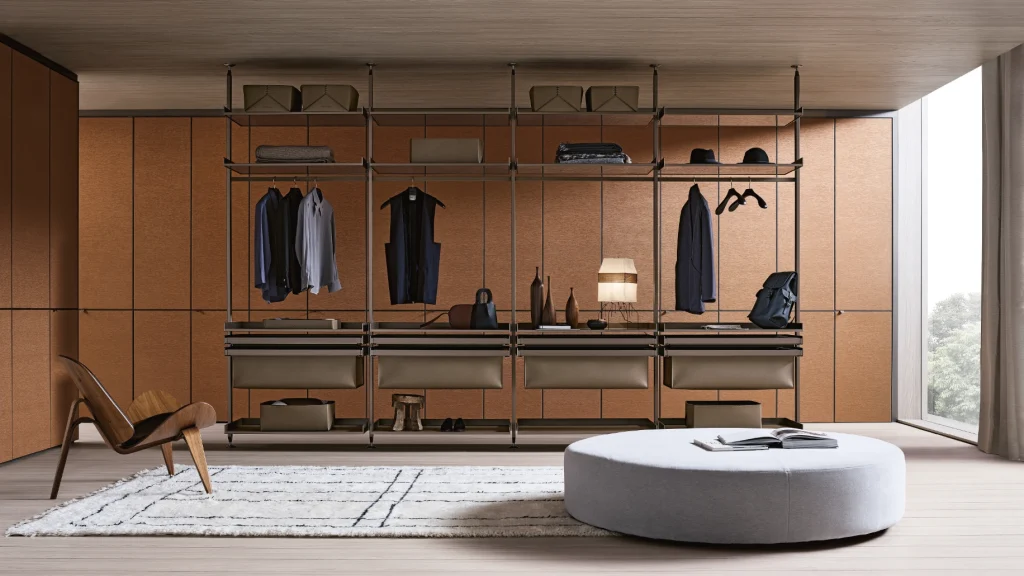
There is a persistent oversight in even the most carefully designed residential projects: the bedroom is treated last, and the closet is resolved in haste. Zenit exists to put an end to that oversight.
There is a gesture we perform every day, before the day begins. We step into the dressing space, open drawers, scan garments with our eyes. It is a private, silent, almost meditative moment, and it takes place in a space that, in most homes, has been treated as an afterthought, functional at the bare minimum, designed last.
This is the contradiction that Zenit, by Rimadesio, makes visible. In an ambitious residential project, every material is chosen with intention. Every surface responds to a compositional plan. Every space has its own logic. Except the closet. The closet is still solved with a standard shelving system, as if the most intimate space in the home did not deserve the same level of attention as the kitchen or the living room.
Zenit proposes an alternative: one in which the walk-in closet is architecture, with the same density of decisions, the same material coherence, and the same permanence over time.
To understand Zenit, one must understand Rimadesio.
Founded in 1956 in Brianza, the heart of high-quality Italian furniture production, the brand built its identity on a principle that is both simple and demanding: materials do not need to be disguised. Their honesty is the finish.
This conviction runs through the entire product line, from doors and partitions to the Zenit system. Glass is glass, treated, lacquered, calibrated in its transparency or opacity, but always recognizable as matter. Wood retains the memory of the tree, in grains that are not homogenized but preserved. Aluminum structures without concealing its constructive logic.
This is what Rimadesio internally defines as material honesty, a philosophy that stands in opposition to the decorative concealment that dominates much of the market.
“In a well-designed system, every element justifies its presence. There is no ornament. There is decision.”
Rimadesio Principle
Zenit was designed by Giuseppe Bavuso, one of the most rigorous names in Italian industrial design. His approach reflects this philosophy: structure is the aesthetic element, and function is inseparable from form.
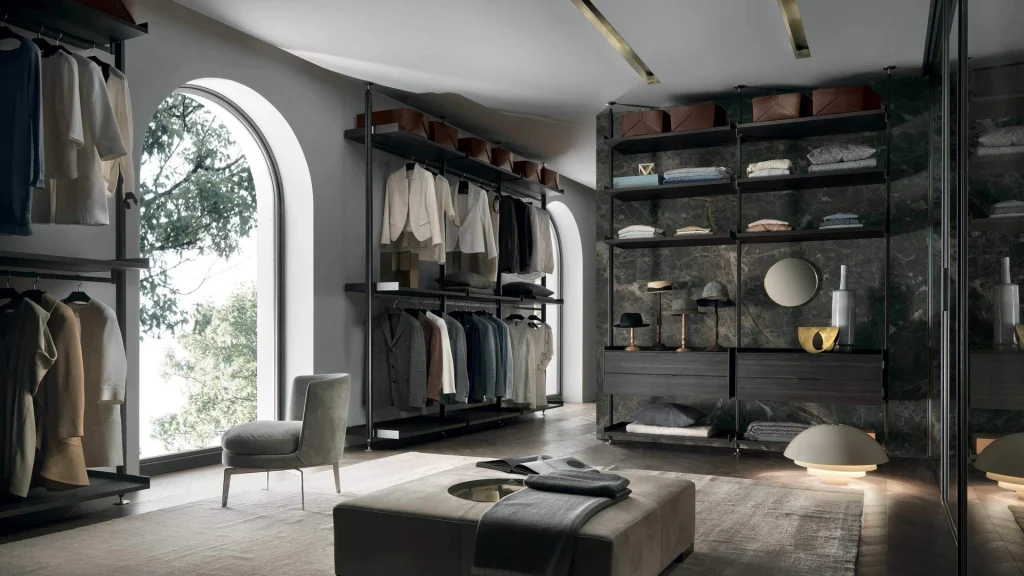
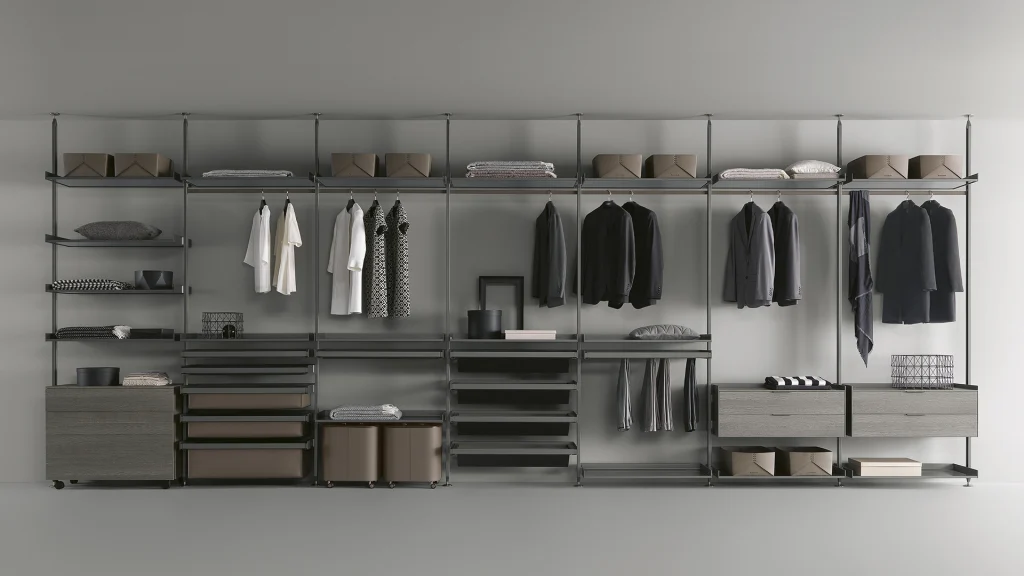
Zenit is organized around a central element: the vertical upright, custom-made, always extending from floor to ceiling.
This element defines the character of the system. There are no gaps at the top, no wasted space between shelf and ceiling height. The closet occupies the space completely.
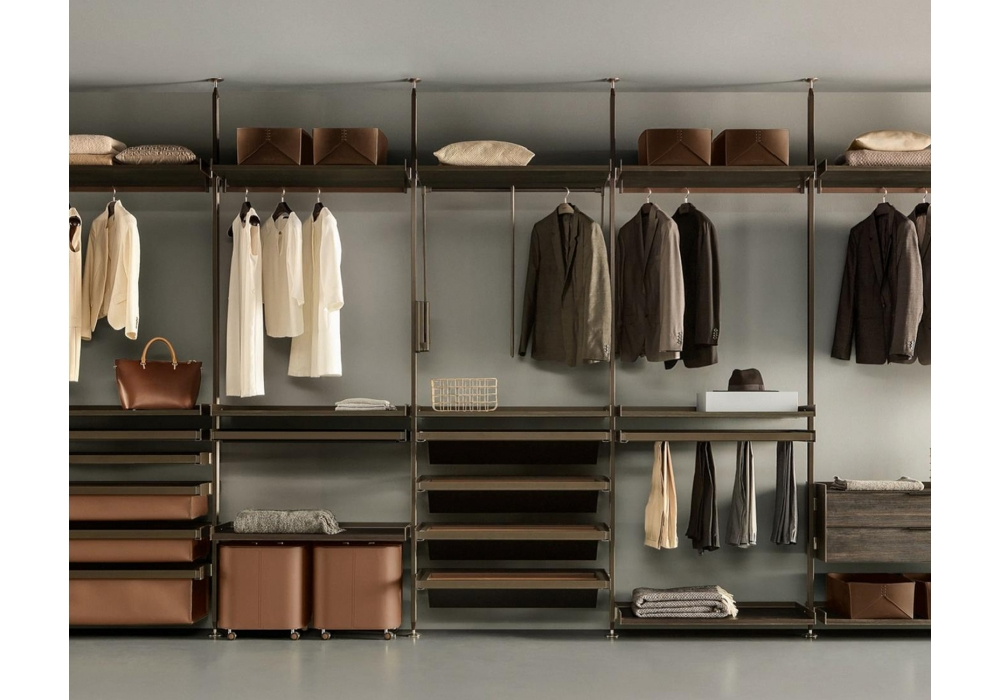
All organizational elements are freely mounted onto these uprights:
The connection system is designed so that any element can be repositioned or replaced without structural intervention.
There are no predefined heights, no fixed modules.
This is not just a technical feature, it is a philosophical stance. Zenit assumes that habits and needs evolve over time, and that an intelligent system should adapt accordingly without becoming obsolete.
Uprights
Custom-made, floor-to-ceiling. Aluminum with a technical expression.
Drawers
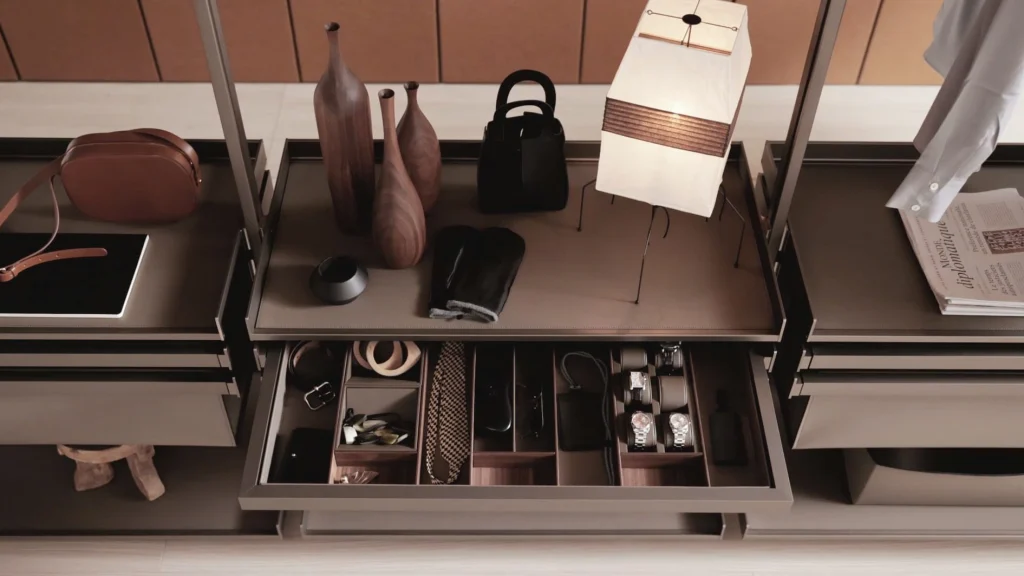
Extruded aluminum. Only 8 mm profile thickness. Soft-close mechanism.
Positioning
All accessories can be repositioned at any point along the upright, with no predefined heights.
Configurations
Linear, corner (L-shaped), and U-shaped. Suitable for walk-in closets and single elevations.
Lighting
Integrated LED within shelves, uprights, and the top of the system.
Customization
Free combination of glass, wood, and aluminum within the same composition.
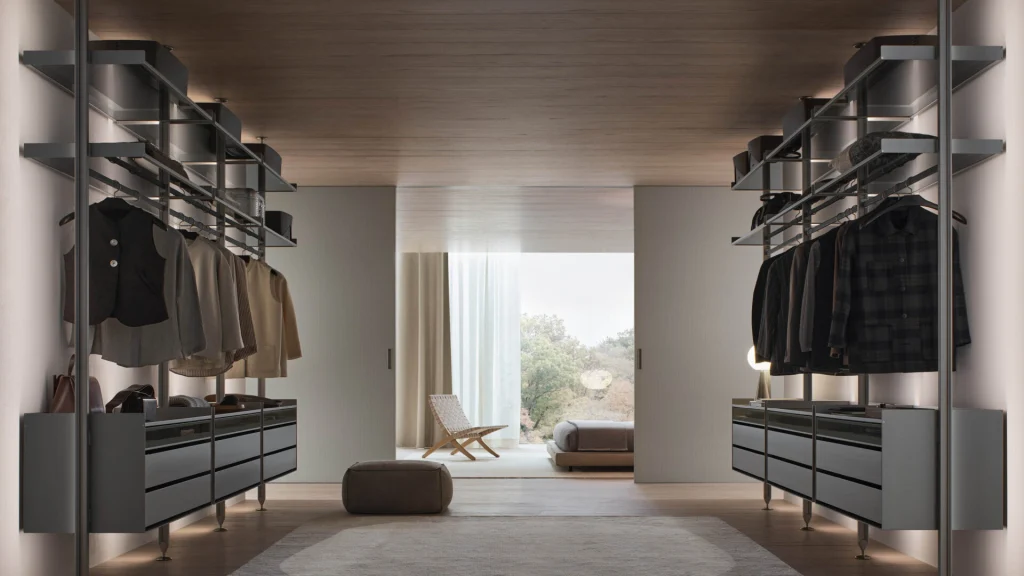
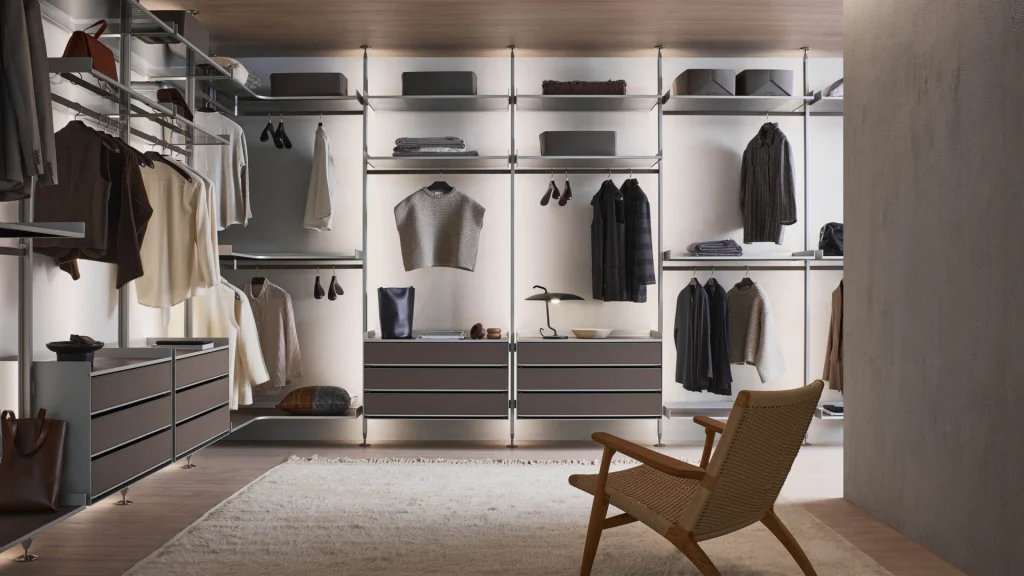
Zenit exists in three main material languages, each with its own character, all capable of coexisting within the same composition.
Lacquered glass
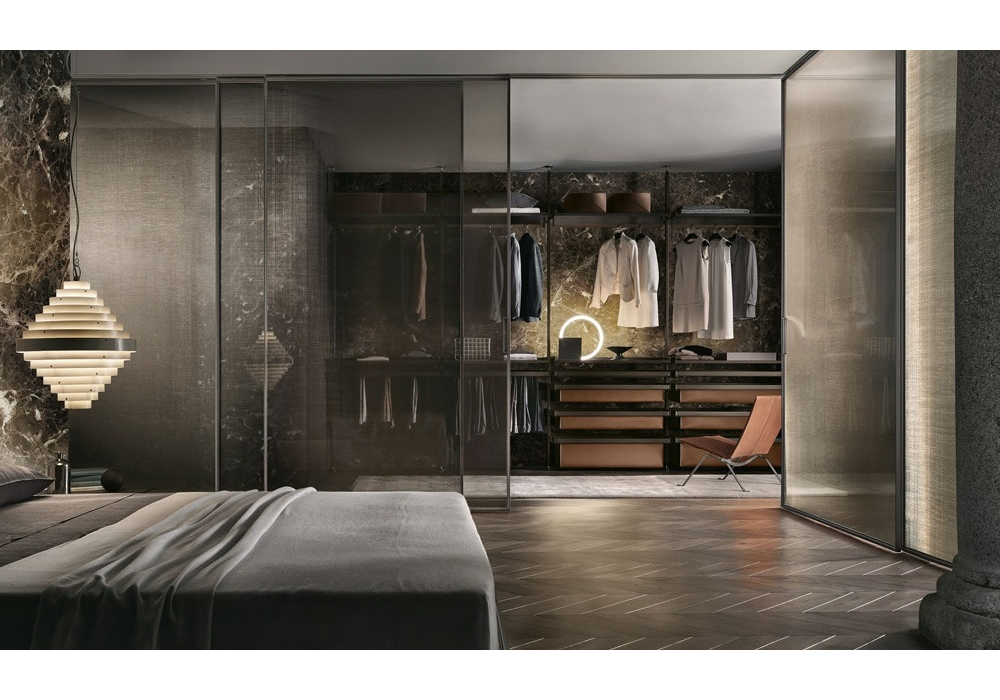
Glossy or matte. Rimadesio’s Ecocolorsystem range, with hundreds of tones. Enhances the perception of light and depth.
Wood
Grey oak, charcoal larch, elm. Introduces warmth, texture, and tactility to the dressing space.
Aluminum
Structure and drawers. A technical, almost post-industrial profile. The visual backbone of the system.
The ability to combine these three languages within a single composition is what makes Zenit distinctive. It is not about choosing a finish, it is about constructing a material plan that dialogues with the bedroom, the suite, and the overall architectural project.
A closet with aluminum uprights, matte white glass shelves, and grey oak drawers is not a random combination. It is a compositional decision with the same intent as an architectural material palette.
Integrating Zenit into a project begins with reading the space, not only its dimensions, but its relationships.
How does light enter? Is there a circulation path the system must respect? Is the walk-in visible from the bedroom, or is it a separate space?
Zenit’s configurational flexibility, linear, L-shaped, or U-shaped, makes it suitable for both large walk-in closets and single elevations where the wardrobe becomes the main element.
In every case, the specification follows a clear logic:
Zenit is not a starting point. It is an arrival.
It is the decision of those who want to treat personal space definitively, with a system that does not visually age, that evolves with its user, and that aligns with the level of ambition of the overall project.
It is a natural choice:
It is not for those seeking speed or the lowest price. It is for those who understand personal space as a long-term investment.
There is an implicit coherence in a well-designed home: there is no lesser space, no space that deserves less attention, no space resolved in haste simply because it is unseen.
The bedroom, and the closet that is part of it, is the most private part of the home. It is where the day begins.
Zenit, by Rimadesio, makes it possible to treat that space with the same intention as the rest.
Not through ostentation, but through rigor, the only approach that does not age.